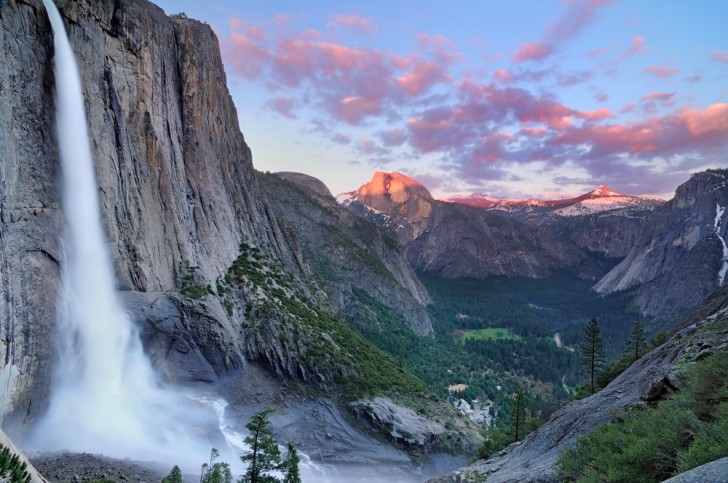
Yosemite is one of the most well known national parks in the world. With over 3.7 million visitors every year, this California park is an incredibly popular nature destination in the United States. Yosemite National Park is known for its awe-inspiring granite cliffs, cascading waterfalls, and over 800 miles (1,300 km) of hiking trails. Half Dome, a massive granite cliff jutting out of the earth, is one of the famous icons of the park, along with Cathedral Peak and El Capitan. Most of Yosemite’s iconic peaks, lakes, and waterfalls are located in the tourist-heavy 7 square mile (18 sq. km) area of Yosemite Valley, but the entire… See more pictures of Yosemite National Park, California, United States
Lake Powell is a man-made reservoir on the Colorado river. Located in the United States between Utah and Arizona, Lake Powell is surrounded by magnificent Navajo sandstone canyon walls in bright oranges, reds, and whites. These striking colors contrast beautifully with Lake Powell’s blue-green waters. Lake Powell is a sprawling, winding lake, and is the second largest man-made lake in the United States. The lake was made when Glen Canyon Dam was constructed in the early 1960s, flooding Glen Canyon. The lake, along with Horseshoe Bend and the notable Rainbow Bridge National Monument rock formation, is now part of the Glen Canyon National Recreation… See more pictures of Lake Powell, Utah and Arizona, United States
Yehliu is the name of a rocky cape on the northeast coast of Taiwan. The cape is known for the interesting rock formations that were formed when ocean waves eroded part of the rocky shore. The formations, called hoodoos, can be seen in the Yeliu Geopark. Some of the rock formations have names based on objects that resemble their shapes. The most famous hoodoo is called “the Queen’s Head.” Yehliu is within the town of Wanli which is between the cities of Taipei and Keelung.
Easter Island is an isolated Polynesian island located in the southeastern Pacific Ocean. Politically, Easter Island is a special territory of Chile. Easter Island is famous for the almost 900 stone statues, called moai, that are in the shape of human heads and simple bodies. These moai statues were created by the Rapanui people hundreds of years ago. It is believed that the Rapanui people’s numbers dwindled due to the overexploitation of their tiny, isolated island. Others claim diseases from Europe are to blame for the decline. The island’s name was given in 1722 by a Dutch explorer, who landed on the island on Easter Sunday. The Polynesian name for the island is Rapa Nui, meaning “Big Rapa” in reference to a similar looking Polynesian island called Rapa. Today, Easter Island is a UNESCO World Heritage Site, and destination for history loving tourists. See more pictures of Easter Island
Washington DC is the capital of the United States. More formally known as the District of Columbia, this federal district is not part of any one state, though it is bordered by the states of Maryland and Virginia. Washington DC is home to many of the important government buildings of the United States, including the White House and the US Capitol Building. But that’s not all this magnificent city is known for. Washington DC is also a hotbed a culture, housing some of the finest art and history museums in the United States. And of course, there are the many impressive monuments, including the Lincoln Memorial, the towering Washington Monument and reflecting pool, the Jefferson Memorial, the National World War II Memorial, the Korean War Veterans Memorial, the US Marine Corps Memorial, and the Vietnam Veterans Memorial. Other popular stops for visitors include the Library of Congress, and the 19 museums operated by the Smithsonian Institution. The city is also known for its performing arts centers, including the John F. Kennedy Center for the Performing Arts (home to the National Symphony Orchestra), the Washington National Opera, and the Washington Ballet. Nature-loving tourists flock to the city in the spring when the cherry blossom trees that line the city’s streets are in full bloom. See more pictures of Washington DC, United States
The beautiful and somewhat eerie ruins of Kilchurn Castle lie on the northeastern shore of Loch Awe in Scotland. Its construction dating back to the 15th century, Kilchurn Castle was originally built on a tiny island. The loch’s water levels were changed in 1817 causing the island to connect to the mainland. While the oldest part of Kilchurn Castle was built in 1450 by Sir Colin Campbell, subsequent residents continued to add on to the castle until 1681. The Kilchurn Castle ruins are open to the public only during the summer months, via the A85 road. See more pictures of Kilchurn Castle, Loch Awe, Scotland
Horseshoe Bend is a picturesque horseshoe-shaped turn in the Colorado River, just South of the town of Page, Arizona. Visitors can reach Horseshoe Bend by taking a short 1/2 mile (0.8 kilometers) hike off US Route 89 to an overlook 1,000 feet (405 meters) above the river. Horseshoe Bend is part of Glen Canyon, which was carved by the Colorado River over a period of 5 million years. Glen Canyon is also home to the beautiful Lake Powell. Horseshoe Bend is popular with photographers and tourists who seek the beautiful canyon scenery. See more pictures of Horseshoe Bend, Colorado River, Arizona, USA
Fingal’s Cave is located on the uninhabited rock island of Staffa, off the West coast of Scotland. This fascinating cave is formed from hexagon shaped basalt columns. The basalt formed into hexagonal columns when a lava flow cooled in the ocean. The lava flow that created Fingal’s Cave also created the amazing Giant’s Causeway rock formation in Scotland. In Gaelic, Fingal’s Cave is known as Uamh-Binn, meaning “cave of melody”, due to the lovely sounds made by echos of waves crashing inside. See more pictures of Fingal's Cave, Staffa, Scotland